CeDAR - Ventral Hernia

CeDAR - Ventral Hernia Summary
CeDAR - Ventral Hernia is a free iOS app in Medical by Carolinas Surgical Innovation Group, LLC. Released in Mar 2014 (12 years ago). It has 2.00 ratings with a 5.00★ (excellent) average. Based on AppGoblin estimates, it reaches roughly 5.00 monthly active users . Store last updated Dec 17, 2018
CeDAR - Ventral Hernia SDKs Summary
CeDAR - Ventral Hernia was last scanned for SDKs on 2026-05-15. No known SDKs were detected. Check the raw list of SDK parts detected here and feel free to request unknown SDKs be added to AppGoblin.
5★
Ratings: 2.00
Screenshots


App Description
Hernia repairs are among the most common operations performed in the world. Historically, quality was measured almost solely by recurrence rates. Now that routine mesh use has made these repairs much more durable, wound problems after surgery are the major reason for increased cost of surgery, including the added cost of other procedures, hospital stays and clinic visits because of wound problems up to a year after hernia repair. Because of their wounds, these patients often are not able to work and lose time and money because of specialty wound care, travel, clinic visits and/or hospital stays.
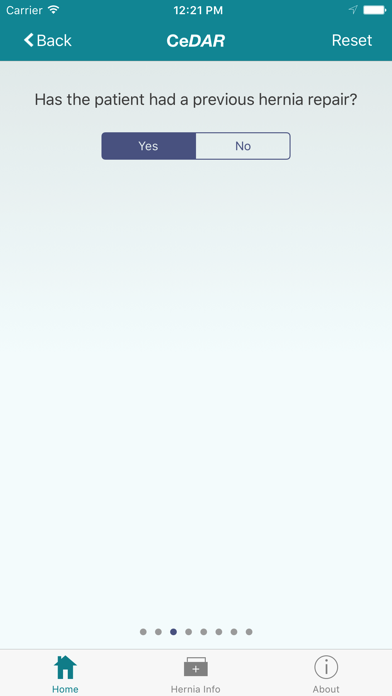
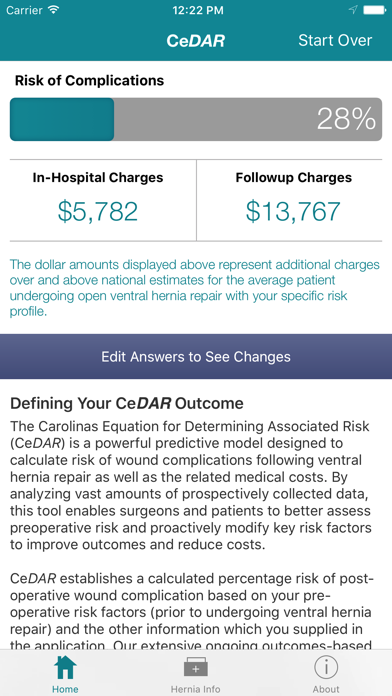
We believe assessing and understanding a patient's preoperative health status can significantly impact postoperative outcomes. The Carolinas Equation for Determining Associated Risks (CeDAR) predicts the risks and financial impact of wound-related problems following ventral hernia repair. The complex mathematical equation, which was calculated from data taken from patients around the world after their surgery, has been independently tested and found to be accurate and reliable. With the aid of mobile app technology, CeDAR now provides surgeons and patients with a powerful tool that can predict individualized wound outcomes after abdominal hernia surgery. Moreover, it offers patients detailed educational materials about many types of hernias and their treatments. Users simply answer eight questions about themselves, including height and weight. Based on these answers, a percentage chance of developing specific postoperative complications requiring treatment is calculated along with the corresponding cost of this treatment. These results can then be used to discuss an individual patient's risk for wound problems after surgery and what they can change to improve their odds for a good result.